

Out-of-home advertising has never been just about putting an advertisement on a billboard.
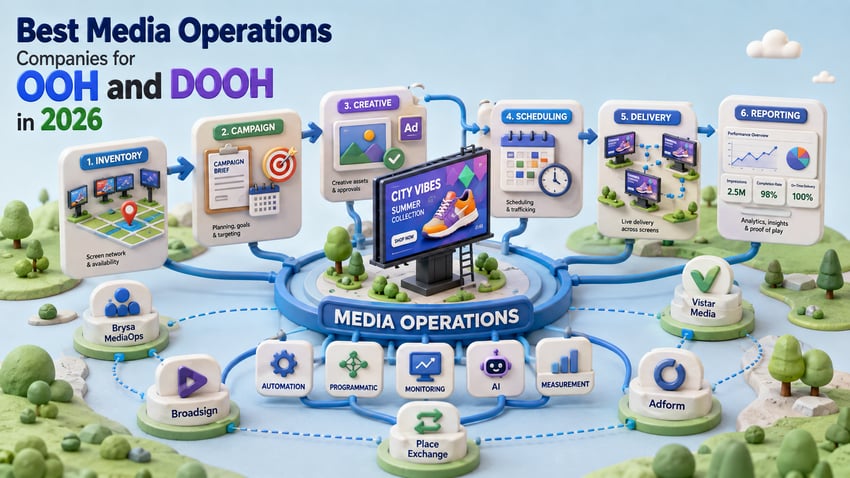
Behind every successful OOH or DOOH campaign is an operational chain that has to work: inventory needs to be available, campaign specifications need to be correct, creative assets need to be approved, screens need to be scheduled, campaigns need to deliver as contracted, and proof of delivery needs to be available when the campaign is complete.
That becomes considerably harder when a media business manages hundreds or thousands of screens, multiple markets, different creative formats, direct and programmatic campaigns, and increasingly demanding advertisers.
This is where media operations becomes critical.
The right technology or operations partner can reduce the amount of manual coordination required to run campaigns while giving media teams better control over inventory, delivery, creative, reporting, and revenue.
But there is an important distinction that is often missed in discussions about the OOH technology market:
Not every company described as a "DOOH platform" is a media operations company.
Some companies provide screen-management and content-management software. Some operate supply-side platforms. Some provide demand-side buying technology. Others focus on programmatic transactions, while media operations providers focus on the workflows that connect all these systems.
That distinction matters when choosing a partner.
This guide evaluates leading companies across the OOH and DOOH ecosystem based on the operational problems they help solve, rather than simply ranking them by screen count or market visibility.
Key Takeaways
|
The Best Media Operations Companies for OOH and DOOH
There is no universal "best" provider because OOH and DOOH businesses have different operating models.
A large digital billboard network may need inventory management and programmatic monetisation.
An agency may need campaign planning, audience targeting, and measurement.
A growing media owner may have a different problem altogether: too much campaign administration, too many spreadsheets, too many emails, and not enough operational visibility.
With that distinction in mind, these are some of the companies worth evaluating in 2026.
Quick comparison
|
Company |
Strongest capability |
Best suited for |
|
Brysa MediaOps |
Media operations and workflow automation |
OOH/DOOH businesses looking to scale operations |
|
Broadsign |
OOH software, screen management and monetisation |
Large media owners and digital screen networks |
|
Vistar Media |
Programmatic OOH infrastructure |
Media owners, agencies and advertisers |
|
VIOOH |
Programmatic DOOH supply |
Media owners seeking programmatic demand |
|
Hivestack |
Programmatic DOOH |
Data-driven DOOH activation |
|
Place Exchange |
Programmatic OOH infrastructure |
Buyers and media owners |
|
Adform |
Omnichannel media activation |
Advertisers and agencies running DOOH alongside digital |
The companies above should not be viewed as identical competitors. They occupy different positions in the OOH/DOOH technology and operations stack.
That difference is one of the most important considerations when evaluating them.
7 Best Media Operations Companies for OOH and DOOH in the UK
The following companies stand out for different reasons across the UK and wider European OOH/DOOH ecosystem.
1. Brysa MediaOps
Best for: End-to-end OOH and DOOH media operations
Brysa MediaOps focuses on the operational layer behind OOH, DOOH, and retail media campaigns. Rather than concentrating on only inventory, buying, or screen management, it addresses the workflows that connect campaign setup, creative coordination, execution, monitoring, and reporting.
This makes it particularly relevant for media businesses where campaign volumes are growing, but operations still depend heavily on spreadsheets, emails, manual checks, and disconnected systems. By standardising and automating repetitive workflows, MediaOps can help teams improve operational visibility while scaling campaign delivery more efficiently.
Where it fits: The media operations and workflow automation layer, connecting campaign execution, creative workflows, monitoring, reporting, and operational processes.
Best fit: OOH and DOOH media companies looking to reduce manual AdOps work and build a more scalable operating model.
2. VIOOH
Best for: Programmatic DOOH and inventory monetisation
VIOOH is a major supply-side platform for programmatic DOOH, helping media owners manage and monetise digital inventory while connecting it with programmatic demand. Its capabilities span inventory management, programmatic trading, campaign planning, and access to DSP demand. VIOOH says it works with more than 50 DSP partners globally.
Its UK relevance is particularly strong because the UK has been an established market for programmatic DOOH, with adoption continuing to grow.
Where it fits: The DOOH supply-side and programmatic trading layer, connecting media-owner inventory with programmatic demand.
Best fit: UK and European DOOH media owners looking to expand programmatic demand and improve inventory monetisation.
3. Broadsign
Best for: Large-scale OOH and DOOH network management
Broadsign provides technology for operating and monetising digital OOH networks, with capabilities covering areas such as content management, campaign scheduling, inventory, and programmatic advertising.
Its strength is particularly relevant for media owners managing large numbers of digital screens, where campaign delivery, scheduling, inventory availability, and network operations need to work reliably at scale.
Broadsign has also become more significant in the programmatic ecosystem following its combination with Place Exchange, bringing together complementary OOH infrastructure and supply-side capabilities.
Where it fits: The OOH/DOOH network management and media-owner technology layer, covering screen operations, content, scheduling, inventory, and monetisation.
Best fit: Large OOH media owners, digital signage operators, and businesses managing extensive screen networks.
4. Vistar Media
Best for: Programmatic OOH and audience-driven activation
Vistar Media focuses on programmatic OOH, connecting advertisers and media owners through technology for planning, activation, targeting, and measurement.
Its importance comes from helping OOH operate more like a data-driven digital channel. Buyers can plan campaigns around factors such as audience, geography, timing, and contextual signals, while media owners gain access to programmatic demand.
Vistar also works across the supply-side infrastructure, and its technology supports integration with other parts of the programmatic ecosystem.
Where it fits: The programmatic OOH layer, connecting media inventory with demand while supporting planning, targeting, activation, and measurement.
Best fit: Agencies, advertisers, and DOOH media owners focused on programmatic and audience-based campaigns.
5. Hivestack
Best for: Data-driven programmatic DOOH
Hivestack specialises in programmatic DOOH, connecting digital OOH inventory with automated buying, audience data, and campaign measurement.
Its positioning is particularly relevant for advertisers and agencies looking to make DOOH campaigns more targeted and data-driven. For media owners, the platform provides programmatic infrastructure that can help connect inventory with additional sources of demand.
Hivestack is now part of Perion, reflecting the broader consolidation taking place across the DOOH technology market.
Where it fits: The programmatic DOOH and data-driven activation layer, connecting inventory with automated buying, audience targeting, and measurement.
Best fit: Advertisers, agencies, and media owners looking for data-driven programmatic DOOH.
6. Adform
Best for: Integrating DOOH into omnichannel campaigns
Adform takes a broader approach than OOH-specific technology providers. Its platform allows advertisers to incorporate DOOH into wider media campaigns alongside display, video, CTV, mobile, audio, and other digital channels.
This is valuable for brands and agencies that do not want DOOH to operate as a separate media activity. Instead, they can include it within broader planning, activation, optimisation, and measurement workflows.
Adform is also listed among the major buy-side platforms in the current DOOH programmatic landscape.
Where it fits: The omnichannel media activation layer, bringing DOOH into broader digital advertising workflows.
Best fit: Agencies and advertisers running integrated, cross-channel campaigns.
7. Place Exchange
Best for: Programmatic OOH connectivity
Place Exchange has been an important part of the programmatic OOH ecosystem, providing infrastructure that connects OOH inventory with programmatic demand. Its capabilities have included inventory management, campaign workflows, creative approvals, and reporting.
Its position should be understood in the context of the current market: Place Exchange is now part of Broadsign, following the combination of the two businesses. This makes it less appropriate to present Place Exchange as a completely independent competitor to Broadsign.
Where it fits: The programmatic OOH connectivity and transaction layer, bridging OOH supply with programmatic buyers.
Best fit: OOH media owners, agencies, and buyers that need programmatic connectivity and campaign infrastructure.
The Important Question: Which One Is Actually Best?
There is no honest answer to this question without knowing what part of the OOH/DOOH operation needs to improve.
A company looking for a screen management platform should not necessarily choose the same provider as an agency looking for a programmatic buying platform.
Likewise, a media owner struggling with manual campaign operations may need something completely different.
Consider the following:
|
If your primary problem is... |
Look for... |
|
Managing screens and digital signage |
OOH CMS/network management |
|
Selling inventory programmatically |
SSP / programmatic infrastructure |
|
Buying DOOH programmatically |
DSP |
|
Managing campaigns across channels |
Omnichannel platform |
|
Managing repetitive campaign operations |
MediaOps / workflow automation |
|
Improving campaign monitoring |
AdOps / operational monitoring |
|
Improving inventory monetisation |
SSP + yield management |
|
Connecting fragmented workflows |
Media operations platform |
This is why simply publishing a list of the "top DOOH platforms" can be misleading.
The best technology depends on where the operational bottleneck actually exists.
The Role of AI in Media Operations
AI is becoming increasingly relevant to DOOH operations, but the most useful applications are not necessarily the flashy ones.
The practical value is often in assisting operators with large amounts of operational information.
For example, AI can help:
- Identify unusual delivery patterns
- Summarise campaign performance
- Prioritise operational exceptions
- Extract information from campaign briefs
- Classify campaign requirements
- Assist with creative checks
- Generate operational summaries
- Identify missing campaign information
- Support reporting workflows
This is especially relevant as programmatic DOOH becomes more integrated into mainstream programmatic planning.
VIOOH's 2026 research found that 89% of recent pDOOH buyers had planned pDOOH as part of wider digital programmatic activity during the previous 12 months.
That means the operational expectation is changing.
DOOH increasingly needs to work at the speed and level of automation expected from other digital media channels.
Final Verdict
The OOH and DOOH technology landscape is becoming more sophisticated and more fragmented.
There are platforms for screen management, programmatic buying, supply-side monetisation, campaign planning, measurement, and omnichannel activation.
That is why the question should not simply be:
"Which is the best DOOH company?"
The better question is:
"Which part of the media operation needs to become better, faster, and more scalable?"
For programmatic infrastructure, companies such as Vistar Media, VIOOH, Hivestack and Place Exchange have important roles in the ecosystem.
For OOH technology and network operations, Broadsign is a significant player.
For omnichannel activation, Adform offers a broader media approach.
For businesses focused specifically on the operational layer, connecting workflows, reducing manual work, improving campaign execution and creating scalable processes, Brysa MediaOps represents a different category of solution.
And that distinction is becoming increasingly important.
As OOH becomes more digital, programmatic and data-driven, the competitive advantage will not come only from having more screens or more technology.
It will increasingly come from how efficiently the entire operation works behind those screens.