

A campaign goes live on a Monday. The creative is beautiful, the insertion order is signed, and the advertiser is a retail brand spending well into six figures on a seasonal push. On the following Wednesday, nine days later, someone in the advertiser’s team notices that the impressions are landing, but the click-through rate on one placement is essentially zero. It turns out the tracking tag on that line item was copied from the previous campaign. The creative was serving. Nothing was being measured. Nine days of a flagship campaign, unattributable.
Nobody was careless. An operator under time pressure duplicated a line item to save fifteen minutes, which is exactly what duplicating a line item is for. The tag came along for the ride. There was no step in the process where anyone would have caught it.
This is what ad trafficking errors actually look like. Not dramatic, not obviously negligent, and almost never noticed by the person who made them. This guide walks through the errors that recur most often, why standard fixes fail to stop them, and what an operating model that prevents them looks like in practice.
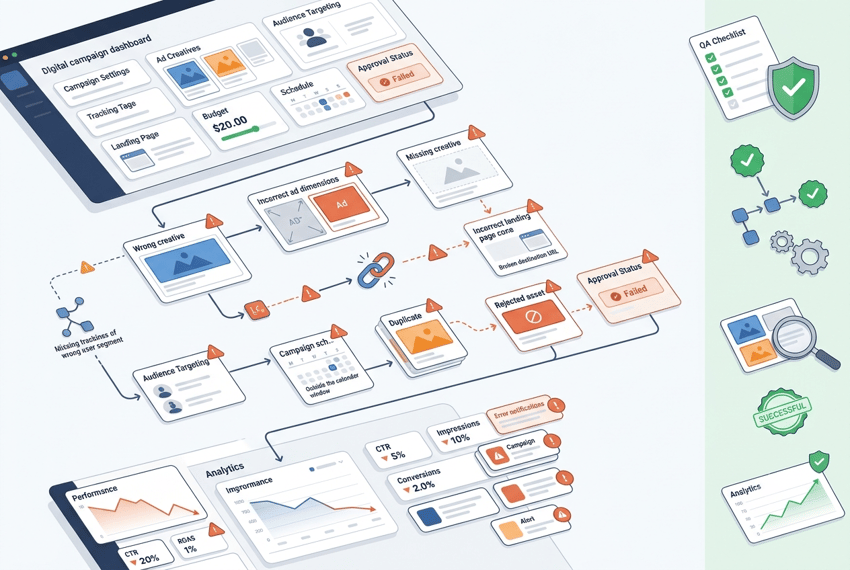
Key Takeaways
|
Trafficking Is Invisible Until the Invoice Arrives
Ad trafficking is the least glamorous part of the media business and the one with the most direct line to revenue. It is the work of taking a signed insertion order and turning it into a live, correctly targeted, correctly measured, correctly billed campaign. When it is done well, nobody mentions it. When it goes wrong, it goes wrong in the one place everybody looks: the numbers.
The scale of leakage in digital advertising is already well documented. The ANA’s Programmatic Transparency Benchmark put wasted programmatic spend at $26.8 billion as of its August 2025 edition, up from $20.0 billion when the first benchmark was published in June 2023. That figure covers supply chain waste, not trafficking mistakes. Trafficking errors sit on top of it, and they are entirely self-inflicted.
They also have contractual teeth. The 4A’s/IAB Standard Terms and Conditions treat a delivery discrepancy of under 10% as tolerable. Above that threshold, the parties are pushed into reconciliation, and where it cannot be resolved, the agency can treat the gap as under-delivery and demand a make-good. A trafficking error that suppresses delivery by 12% is not a tidy-up. It is inventory given away for free, a credit note, and a conversation with an advertiser who now watches you more closely.
For media owners, this is the quiet arithmetic of ad operations. The error costs an hour to fix and a quarter to recover from. As we have argued in rethinking ad operations for marketing ROI, the function is treated as a cost centre right up until the moment it decides whether revenue is recognised.
Six Errors That Quietly Break Campaigns
The same handful of mistakes recur across ad servers, across formats, and across markets. None of them requires incompetence. Every one of them requires only a busy operator and a process that permits it. Here are the 6 errors that quietly break campaigns:
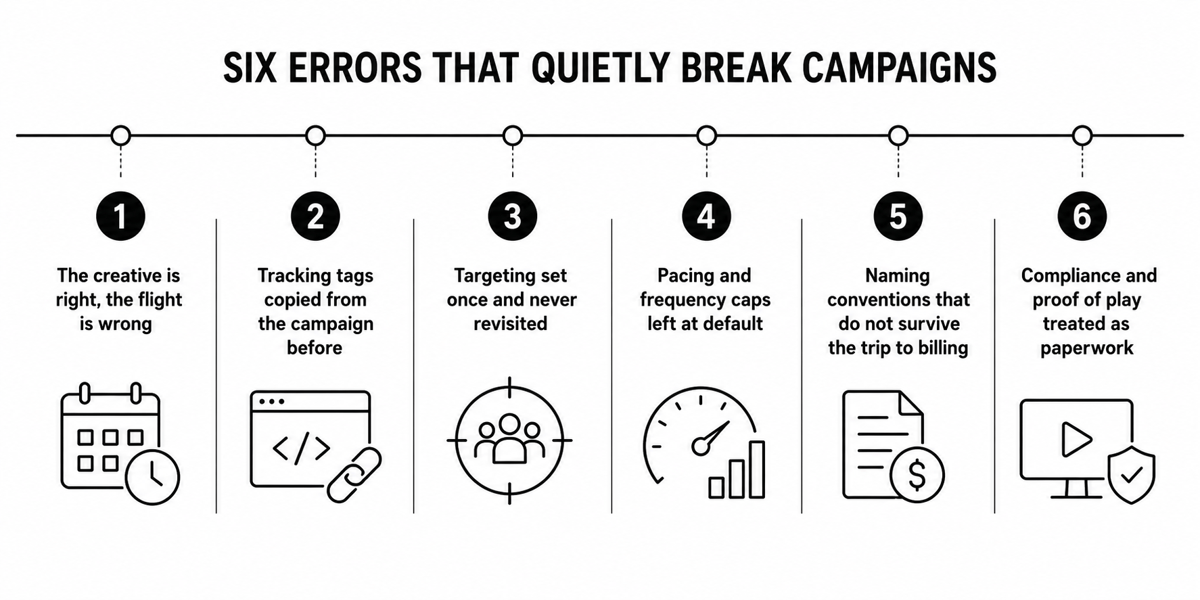
1. The creative is right, the flight is wrong
Start and end dates are typed, not inherited. A campaign booked to launch on the first of the month goes live on the last day of the previous one, or ends a day early, or runs a day long into inventory that was sold to somebody else. Off-by-one date errors are the most common trafficking mistake in the industry and among the hardest to spot, because everything on the screen looks correct.
2. Tracking tags copied from the campaign before
The failure in the opening scene. Duplicating a line item is the fastest way to set up a similar campaign and the fastest way to inherit the wrong click tracker, the wrong impression pixel, or a macro that no longer resolves. The ad serves perfectly. The measurement points to a campaign that ended weeks ago, and the advertiser sees a placement that appears to do nothing.
3. Targeting set once and never revisited
Geography, daypart, audience segment and device targeting are configured at setup and treated as settled. Segments expire. Postcode lists go stale. An audience built for a previous flight quietly shrinks until delivery cannot possibly be completed, and the campaign under-delivers for a reason nobody thinks to check, because the targeting was correct on the day it was entered.
4. Pacing and frequency caps left at default
The ad server has a default. The insertion order has a commitment. They are rarely the same thing. Left alone, a campaign front-loads its impressions in the first week, exhausts the budget before the retail moment it was booked for, and delivers the contracted number of impressions to the wrong half of the flight. The delivery report is green. The campaign failed anyway.
5. Naming conventions that do not survive the trip to billing
Placement names are written for the operator setting them up, not the system that will reconcile them. When the ad server, the order management system and the finance ledger disagree on what a line item is called, reconciliation becomes manual matching by process of elimination. That is where billing discrepancies are born, and it is the reason a delivery problem is often discovered by an accountant.
6. Compliance and proof of play treated as paperwork
In DOOH, this one is expensive. Screens go offline, loops get rescheduled, and a play does not happen. If proof of play is verified only when an advertiser complains, a media owner is invoicing for delivery that it cannot evidence. The operational demands of digital out-of-home are what separate the networks that scale from those that stall.
The Difficult Truth: The Error Is Never the Root Cause
Read that list again, and something becomes obvious. Not one of those six is a knowledge problem. Every operator on your team knows that flight dates matter and that tracking tags should be checked. They make the mistake anyway, because the process allows the mistake to be made and provides no moment at which it is caught.
This is why training does not fix trafficking errors, and why a checklist taped to a monitor fixes them for about three weeks. The error rate is a property of the system, not of the people inside it.
The system, in most media businesses, is manual. Fluency’s 2026 Agency AdOps Benchmark Report, which surveyed more than 170 US agencies and in-house advertising teams, found that 71% of ad operations teams say manual processes are putting client campaigns at risk. The same research put routine campaign tasks at 39.75 hours per strategist per month, with 87% still pacing budgets by hand. Nearly a full working week, every month, is spent on the exact repetitive configuration work where human attention is least reliable and most expensive.
Scale then does what scale always does. Ten campaigns a month can be trafficked by careful people improvising. Two hundred cannot. Every operator develops their own way of setting up a line item, and no two campaigns are built the same way, so no error is ever systematically visible.
Trafficking errors are the first place that collision shows up. They are the early warning that the operation has outgrown the way it is run. Remember - Manual work is not there because nobody has noticed it. It is there because the workflow was never designed, only accumulated.
Also Read: The Truth About Ad Ops Efficiency
Prevention Is a System, Not a Checklist
Preventing trafficking errors means removing the conditions that produce them, rather than asking people to be more careful. The following five controls do most of the work:
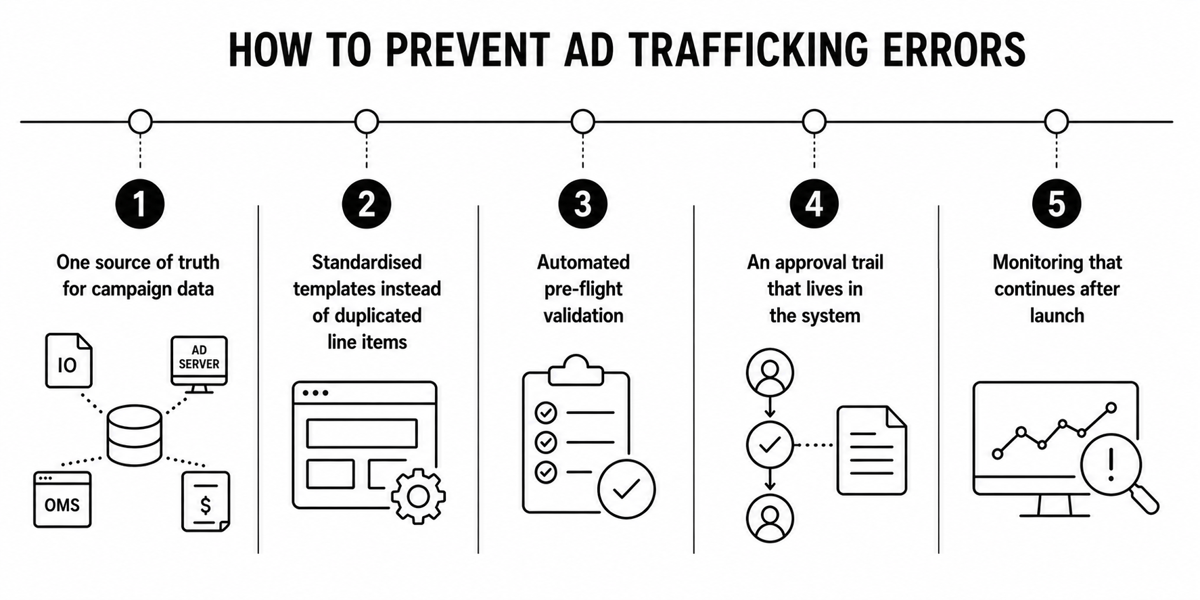 1. One source of truth for campaign data
The insertion order, the ad server, the order management system and the billing ledger should read from the same record. When campaign data is re-keyed from a signed IO into an ad server by hand, a transcription error is not a risk. It is a matter of time. Integrating the sold record with the trafficked record eliminates an entire category of mistakes by making it impossible to type.
2. Standardised templates instead of duplicated line items
If duplication is how campaigns get built, inheritance is how errors get built. Templates for each product, format and placement type give every operator the same starting point, with tracking fields deliberately blank rather than pre-filled with the last campaign’s values. The blank field is the point. It forces a decision where duplication permitted an assumption.
3. Automated pre-flight validation
Every rule described in the previous section can be expressed as a check that a machine runs in seconds. Do flight dates match the IO? Does every line item have a unique tracker? Is the pacing setting consistent with the contracted delivery curve? Does the placement name conform to the convention that billing expects? Machines are excellent at exactly the vigilance that humans lose at four in the afternoon.
4. An approval trail that lives in the system
When approvals happen over email and instant message, there is no record of who verified what, and no way to learn from an error after the fact. Separating the person who builds a campaign from the person who signs it off, inside the workflow rather than beside it, converts a trafficking mistake from a mystery into a traceable event.
5. Monitoring that continues after launch
The industry treats launch as the finish line. It is the starting gun. Delivery pacing, discrepancy rates between first-party and third-party measurements, and proof of play should be watched continuously, with thresholds that raise an alert before the 10% mark that triggers a make-good. Catching a discrepancy on day two is an adjustment. Catching it on day twenty is a credit note.
Taken together, these controls describe an operation that runs itself and escalates by exception. This is what we call zero-touch ad operations. The ad tech to do this is not experimental. Platforms such as Salesforce Media Cloud exist precisely to connect the sold order to the delivered campaign to the recognised revenue. What is usually missing is not the tooling. It is the operating design that decides what the tooling should enforce.
The Reconciliation Test
There is a straightforward way for a media owner to know whether any of this is working, and it has nothing to do with how many errors get logged.
Look at how long month-end reconciliation takes and how much of it is manual. If the finance team is matching placements to invoices by hand, chasing operators to explain what a line item was, and negotiating discrepancies with agencies as a routine part of closing the books, then trafficking errors are not occasional. They are structural, and reconciliation is where the business has quietly agreed to absorb them.
A well-run trafficking operation shows up as a boring month-end. Delivery matches the order. The report matches the ledger. Discrepancies sit far below the threshold where anybody has to have a conversation about makegoods. The advertiser renews, not because the campaign was extraordinary, but because nothing about it required their attention.
That is the actual return on operational discipline. Not fewer errors. Fewer conversations about errors and the retained revenue that follows.
The Brysa Effect: Campaigns That Run Exactly as Contracted
The wrong tracking tag is not really a trafficking problem. It is what an unstandardised workflow looks like on the day it finally costs someone money. Which is why buying a better ad server rarely changes the error rate, and why the media businesses that fix this start with the process and let the platform enforce it.
That is the work Brysa does. As a consulting company with deep expertise in media operations, we design the trafficking workflow before we automate it: one source of truth from insertion order to invoice, standardised campaign templates, pre-flight validation that catches the off-by-one date and the inherited pixel, and continuous monitoring that surfaces a discrepancy while it is still an adjustment rather than a credit.
Our MediaOps and Creative Services teams do not hand over a recommendation deck and leave the execution to you. We build the system, we run it alongside your team, and we measure it by the only number that matters, which is, how much contracted revenue you actually recognise.
We call the outcome The Brysa Effect™: campaigns that run exactly as they were sold, month after month, without heroics. It is what “helping you deliver every campaign flawlessly” means in practice, and it is why our clients’ month-ends are unremarkable.
If your reconciliation is a negotiation, the errors have already told you what they cost. Contact our team now to find out what a trafficking operation designed to prevent it looks like.