

In a recent report, two numbers clearly highlight why campaign velocity has stopped being an operational nicety. According to the IAB/PwC Internet Advertising Revenue Report, published in 2026,
- US digital advertising revenue reached $294.6 billion, growing 13.9% year on year,
- Inside that total, programmatic grew 20.5% to $162.4 billion.
The market is growing. But most media businesses are still running an operation built for a world where a campaign was sold in March, trafficked in April, and ran until August.
That mismatch has a name, even if the industry has never settled on one. We call it suboptimal campaign velocity. This guide defines campaign velocity, explains the three forces that turned campaign velocity from an efficiency metric into a revenue metric, walks through where the days actually disappear, and covers the one thing that makes speed dangerous rather than valuable.
Key Takeaways
|
Campaign Velocity, Defined Properly
Campaign velocity is the elapsed time between a confirmed advertiser brief and live, correctly configured, correctly measured delivery. In its fuller and more useful form, it runs further: from brief to reconciled, invoiced, recognised revenue.
It is worth being blunt about the state of the term. There is no IAB standard for campaign velocity. It appears in vendor glossaries and trade columns with slightly different meanings each time, and it is frequently confused with two neighbouring metrics.
- Creative velocity measures how many net-new creative variants a brand produces per unit of time.
- Attention velocity measures how quickly an audience engages once a campaign is live. Both are advertiser-side metrics about performance.
Campaign velocity is a media-owner metric about operations. It measures your business, not the advertiser’s creative.
That absence of a standard definition is not an academic problem. It is the reason most media owners cannot tell you their own number. Ask a publisher how long it takes to get a signed insertion order live, and you will usually get an average that somebody has estimated, a range that reflects the best case, or a genuinely thoughtful answer about the two campaigns everyone remembers. The measurement that matters, median days from confirmed brief to first correct impression, across every campaign in the last quarter, rarely exists as a report.
You cannot improve what nobody owns the number for.
Three Forces That Turned Velocity Into a Revenue Metric
Speed has always been nice to have in ad operations. Three shifts turned it into something that shows up in the revenue line.
1. The money moved to the fastest-turning part of the market
Programmatic growing at 20.5% against a market growing at 13.9% is not just a channel-mix story. It is a cycle-time story. Programmatic budgets are committed, adjusted and withdrawn on timescales that direct-sold operations were never designed to match. A media owner whose booking process takes weeks is structurally disadvantaged in a market where a meaningful share of demand moves in hours, and that share is compounding annually.
2. Campaigns got smaller, shorter and far more numerous
The UK market shows the pattern clearly. Digital ad spend reached £40.5 billion in 2025, growing 10% against UK GDP growth of 1.4%, according to IAB UK’s Digital Adspend study with Oliver Wyman. Retail media inside that total reached £3.8 billion, up 18%.
Retail media, in particular, has changed the unit economics of ad operations. It replaced a small number of large, long campaigns with a very large number of small, short ones, often tied to a promotional window measured in days. The operational load does not scale with revenue. It scales with campaign count. A team that comfortably handled forty campaigns a quarter does not comfortably handle four hundred, and no amount of individual diligence closes that gap.
3. Buyers now benchmark you against self-serve
The buyer who wants to run with you also runs campaigns on platforms where the gap between deciding and delivering is a few minutes. That experience sets the expectation, and it is not a fair comparison, but fairness is not the point. When a brief sits in your queue for nine days, the advertiser is not comparing you to your competitors’ turnaround. They are comparing you to the last thing they bought.
The Stopwatch Test: Where the Days Actually Go
Run a stopwatch across a single campaign from confirmed brief to first correct impression, and the result is almost always the same shape. The work takes hours. The elapsed time takes weeks. Nearly all of the difference is queue.
The lifecycle is familiar.
- A brief arrives and is turned into a proposal.
- Availability is checked, usually in a different system from the one holding the proposal.
- Rates are approved.
- An insertion order is issued, signed, countersigned and filed.
- Creative assets are requested from the advertiser, arrive in the wrong specification, and are requested again.
- The campaign is trafficked.
- Tags are tested, or are not.
- It launches.
- Pacing is monitored manually until somebody notices a problem.
At the end, delivery is reconciled against what was sold, and an invoice is raised that finance may or may not be able to match to the line items.
Count the handoffs in that sequence, and you will find between eight and fifteen, depending on the business. Each one is a queue with a person at the end of it. And critically, most of the waiting is not for a decision that requires judgement. It is for a spec clarification, a missing asset, a signature on a document nobody disputes, or an answer to the question “which version of this is current?”
This is the fragmentation problem in operational form, and it is well recognised across the industry. IAB Europe’s inaugural Attitudes to Digital Advertising Report, published in January 2026 from more than 170 responses across 25 markets, found that only 17% of respondents activate the majority of their campaigns across channels, with media quality and operational complexity ranking as the leading barriers to growth. Efficiency, notably, is now a primary driver of where investment goes: 61% cited performance and outcomes, 56% operational efficiencies and 54% cost efficiencies.
Marie-Clare Puffett, Industry Development and Insights Director at IAB Europe, summarised the finding directly: “This report shows an industry that continues to grow, but where fragmentation is holding progress back.”
Fragmentation is what a queue looks like when you draw it as an architecture diagram. As we have argued in examining why manual work still exists in ad ops, the manual steps survive not because anyone defends them but because no single person owns the end-to-end cycle time they add up to.
What Actually Makes a Media Business Fast
Velocity does not come from working faster. It comes from removing the reasons people have to wait. Here are 4 things that actually make a media business fast:
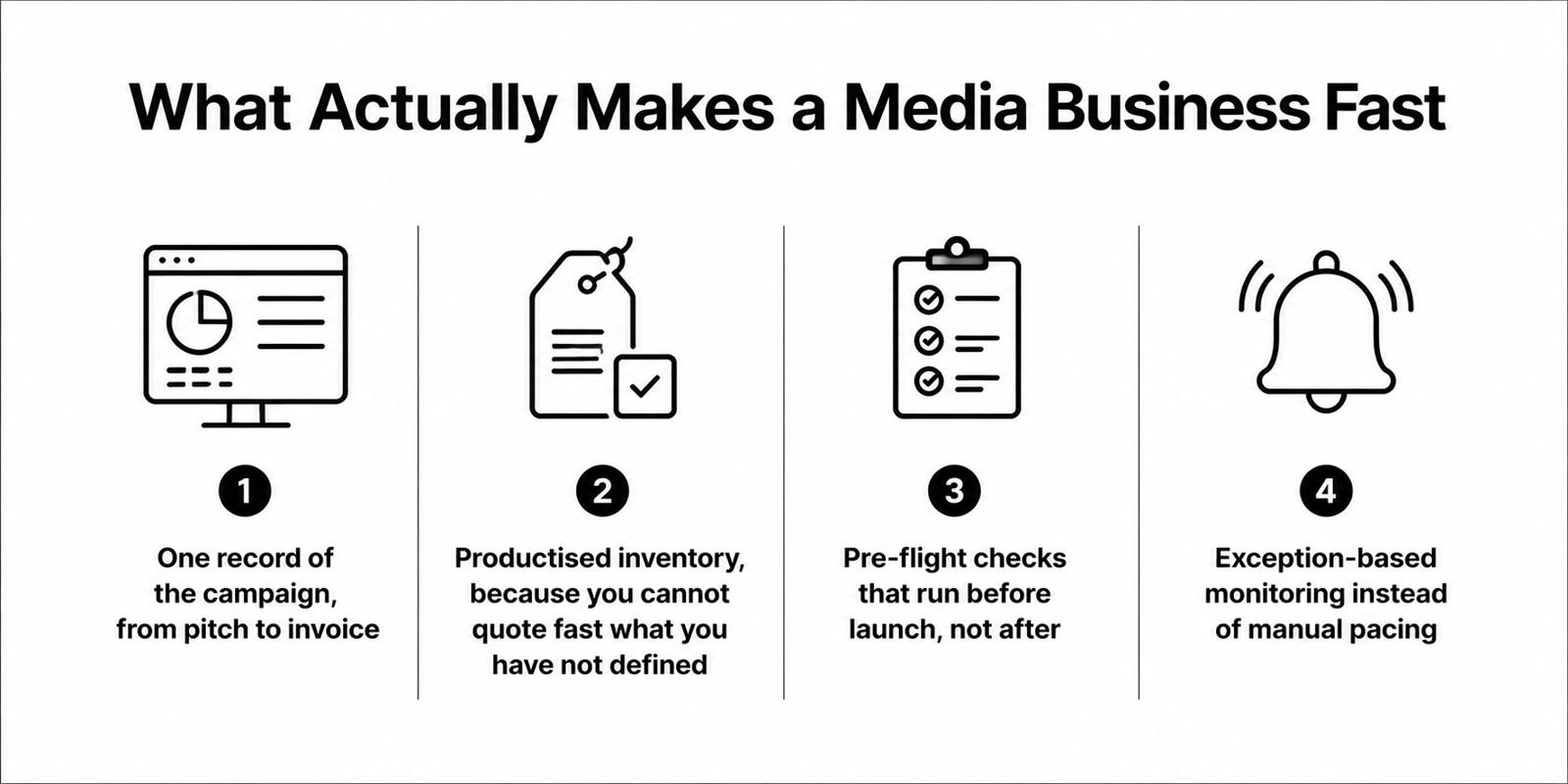
1. One record of the campaign, from pitch to invoice
The single largest source of delay is that the proposal, the order, the trafficking ticket, the delivery report and the invoice are five different objects in four different systems, joined by a naming convention and hope. When the campaign exists once, and every function reads and writes to that same record, most reconciliation work disappears because there is nothing to reconcile. This is the operational case for a platform layer such as Salesforce Media Cloud, and it is a systems decision rather than a process one.
2. Productised inventory, because you cannot quote fast what you have not defined
Bespoke packages are slow by construction. Every one requires a rate decision, an availability check and an approval. A productised catalogue, with defined formats, standard specifications, published rates and pre-approved terms, converts a negotiation into a selection. The bespoke deals still exist. They stop being the default.
3. Pre-flight checks that run before launch, not after
Most quality control in ad operations is detective work performed after something has gone live. Automated pre-flight validation, checking that dates fall inside the flight, that tags resolve, that creative matches the sold specification, that pacing is configured against the contracted delivery, moves the check to the point where fixing it costs minutes. It also removes the most common reason for a launch-day scramble.
4. Exception-based monitoring instead of manual pacing
A team that reviews every live campaign daily is spending its best hours confirming that things are fine. A team that is alerted only when delivery deviates from the plan spends those hours on the campaigns that need intervention. The same headcount handles several times the volume, which is the only sustainable answer to a campaign count that keeps rising. This is the direction we describe in designing a self-driving ad ops engine.
Velocity Without Accuracy Is Just Faster Failure
Here is the caveat that has to sit alongside everything above, because speed is the easiest thing in ad operations to improve badly.
A campaign trafficked quickly and incorrectly does not save time. It costs considerably more than the slow version because the error does not surface internally. It surfaces at the advertiser, in a delivery report that does not match what was sold, weeks after the fact. What follows is a reconciliation, a makegood, a credit note and a conversation in which your operational competence is the subject. The hours saved at setup are repaid several times over, with interest, out of revenue rather than out of time.
This is why velocity has to be defined as time to correct delivery. A metric that rewards launch speed alone will reliably produce faster mistakes, because that is what it is measuring. Media owners that get this right treat accuracy as the constraint and speed as the objective, in that order, and they measure both on the same report.
The distinction matters commercially, too. Advertisers do not actually reward the fastest media owner. They reward the most predictable one, and predictability is what velocity looks like when it has been engineered rather than achieved through effort. A publisher who reliably goes live in four days wins more repeat business than one who occasionally manages two and sometimes takes three weeks.
Brysa Turns Campaign Velocity Into an Operating Model
Most media businesses that come to us about speed have already tried the obvious things. They have added ad ops headcount, bought a workflow tool, and asked the team to prioritise better. Cycle time improved for a quarter and then drifted back because none of those things changed the number of handoffs a campaign has to survive.
As a Salesforce consulting partner with deep expertise in media operations, we work on the collision rather than the symptom.
- We map the real cycle time first, brief to reconciled revenue, with the queues made visible, because almost every business we meet is surprised by where its days actually go.
- We consolidate the campaign into a single record that sales, operations, finance and the advertiser all read from.
- We productise the inventory so that quoting becomes selection.
- We automate the pre-flight checks so accuracy is enforced ahead of launch instead of discovered after it.
- We move monitoring to exceptions, so the team’s attention goes where it changes an outcome.
Through our MediaOps and Creative Services capability, we ensure that the result is not simply a faster team. It is a business where speed is a property of the system rather than an achievement of the people, which means it holds when volume doubles.
If you cannot currently state your median days from brief to live delivery, that is the place to start, and it is a conversation worth having before the next campaign volume increase rather than after it. Contact our team now.