

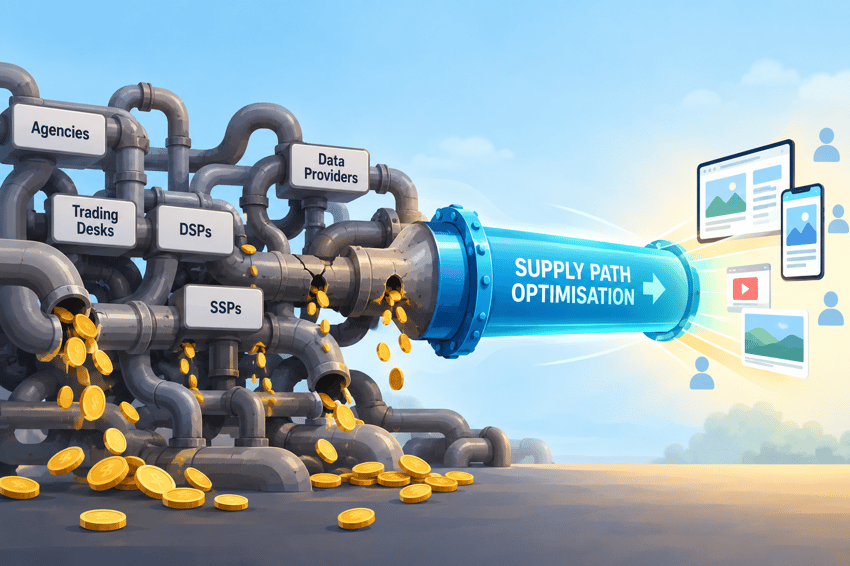
Most advertisers are losing a large part of their budget in the programmatic supply chain. There are just too many middlepeople. Agency trading desks…DSPs…Data providers…It’s a very long list. One American study even proves it. According to it, every dollar that went into a DSP, just 36 cents made it to an actual consumer. 29 cents went as platform fees for DSPs and SSPs. The remaining 35 cents went to impressions that were invalid or couldn’t be measured. This is where supply path optimization (SPO) comes in. It lets buyers trace each impression’s route through all these middlepeople. Then it helps cut the paths that add cost without adding value. In this blog, we are going to understand what SPO is and how it can help media teams cut waste in programmatic advertising.
Key Takeaways
|
What Exactly is Supply Path Optimisation?
SPO is the method of auditing and then subsequently simplifying the routes your ad budgets typically take to reach premium inventory. It’s very similar to buying vegetables. You can go visit a farm and get a kilogram of carrots at £0.5 or get it at £0.7 at your nearest supermarket after it passes through two distributors and one retailer, who each take a cut. In digital advertising, a single ad slot is often sold through multiple supply channels. SPO helps you identify and buy through the shortest and cheapest path.
Why Supply Path Optimisation Matters in Programmatic Advertising?
As we said earlier, there are multiple resellers sitting between you and the publisher. Each of them will add to your budget. In our estimate, it can be anywhere between 10-30% (above the clearing price). When you use SPO, you get to know who exactly takes what. This helps you drop the ones who add nothing.
Also, sometimes, one impression is offered via several SSPs. This pushes your DSP to enter several auctions. This, in turn, will push it to absorb the charges on the ones it loses too. But when you adopt SPO, a good part of your budget goes toward the impressions end up winning.
Finally, long routes are usually where low-quality domains and bad inventories hide. Stick to the shortest path, and you automatically shrink that exposure. A word of caution, though. SPO is not an alternative for verification vendors. You are just getting cleaner supply data.
Also read: From Cost Centers to Profit Engines: Rethinking Ad Operations for Maximum Marketing ROI
How to Implement Supply Path Optimisation Successfully?
Supply path optimisation works best as a repeatable process, not a one-time cleanup. The steps below walk you from mapping your current paths to building rules into your DSP, so the savings hold over time.
Step 1. Pull your log-level data and map the paths
Export at least 30 days of bid-level reports from your DSP. Include attributes like:
- SSP
- Seller ID
- Domain
- Win rate
- CPM
- Fees.
If your DSP won’t give you this, that tells you something about how efficiently you’re buying. Then list every SSP, exchange, reseller, and publisher route your bids travel through, with seller IDs, ads.txt entries, sellers.json records, and schain details where you can get them. Mark every place the same inventory turns up more than once. Those overlaps are usually where you’ll find your first savings.
Step 2. Check who is actually authorised to sell
Match each seller ID against the publisher’s ads.txt and the SSP’s sellers.json. Flag any route where the platform isn’t listed. Highlight the areas where the chain includes resellers nobody can explain. Cutting sellers that aren’t in a publisher’s ads.txt knocks out unauthorised resellers and spoofed domains in one go. So start here.
Step 3. Score every source, not just on price
For each SSP and seller pair, work out cost per win and invalid-traffic rate. Then look at viewability, MFA exposure, conversion quality, and post-click engagement. CPM alone is misleading. This is because cheap inventory can still burn through your budget. Where you can, compare the direct route to the reseller route for the same inventory. Keep paths that sit in the top quartile for win rate. The bottom quartile for fees. Put the rest on hold instead of deleting them. This is because some longer routes reach audiences you actually want.
Step 4. Go direct where it counts, and cut your SSP list
Move your high-value campaigns out of the open auction and into private marketplaces or direct deals. You get clearer pricing and better placements. Then trim the SSP list. Most global and regional campaigns get over 90 percent of their reach from three to five good SSPs. So there’s rarely a reason to keep dozens. Hold on to partners who add real value. And not just extra volume.
Step 5. Pick tech partners who give you control
Look for platforms with transparent reporting and flexible routing. A white-label ad exchange can give you control at the marketplace level. Combining SSP and DSP tools lets you manage both sides of the trade. When you’re vetting vendors, read their reviews on Clutch or G2.
Step 6. Put the rules into your DSP
SPO belongs in your DSP settings. It should not be buried in a spreadsheet. Set an allow-list of preferred SSPs. Block unverified resellers and weak seller paths. Then adjust bids by SSP and use deal IDs for inventory you trust. Test it on one campaign first and check how CPM and win rate move. Then roll it out. After that, the same rules carry across campaigns. This ensures you aren’t redoing the work each time. It also helps to run this alongside your ad account audit so the two stay in step.
Step 7. Review it regularly
Publishers add partners. Exchanges change their rules. Your campaign goals can also shift. This means your approved paths can slowly go stale. Re-score monthly for steady campaigns and more often for high-spend or seasonal ones. Watch for new unauthorised sellers. Keep an eye on win rate, CPM, viewability, and conversion quality. Think of SPO as a regular half-hour routine and not a one-off cleanup.
Also read: The Most Common Ad Trafficking Errors That Hurt Campaign Performance (And How to Prevent Them)
How Can Brysa Help?
At Brysa, we can help you implement SPO by improving your visibility across your entire programmatic campaigns and your supply partners. Our mediaops services help with clearer reporting and campaign optimisation. This means you can evaluate SSP performance and assess where media spend delivers the most value. We can also help strengthen your ad tech infrastructure and automate manual processes, making regular supply path reviews easier to manage. This helps you reduce waste and improve programmatic buying efficiency. Want to know more about how we can help? Contact us now.