

In advertising, growth always adds multiple shades of complexity before capacity. Every new channel introduces another handoff. And a new stakeholder means you have another approval step. Put simply, you are essentially creating a new space for your campaign to fall through the cracks. But is this bad? Absolutely not. Complexity is seldom a sign that your campaign management is broken. It’s just a signal that your process hasn't yet caught up with the level you're now operating at.
So, the question you need to ask yourself is not “how to slow down your growth”. You need to instead ask: “how to build operations that can keep up”. In this blog, we will understand the 5 reasons campaign complexity is growing faster than most MediaOps services teams can handle and what you can do to manage it.

Key Takeaways
|
5 Reasons Why Campaign Complexity is Growing Faster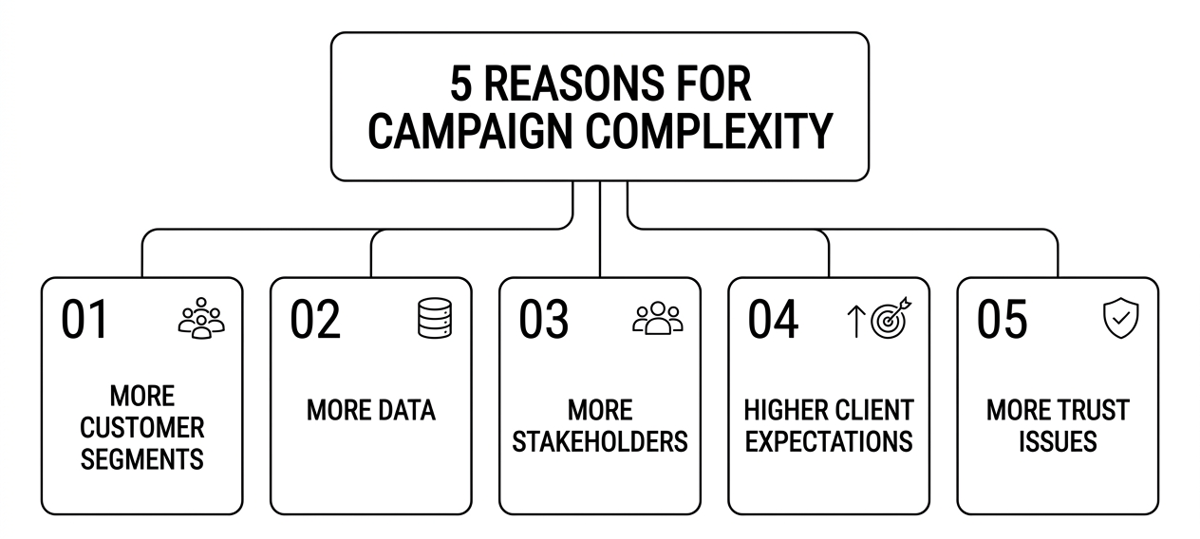
1. Businesses are creating a lot more customer segments
Segmented targeting is gold, no doubt. But excessive segmentation, not so much. It more often than not leads to smaller audiences and insufficient data for reliable optimisation. One study even proves this - campaigns with extremely narrow audience segments can experience up to 30–40% lower statistical confidence in performance data because each segment generates fewer impressions and conversions.
How to solve this: If your campaign contains several segments that differ only slightly, consolidate them. It can improve data clarity and accelerate optimisation cycles.
2. A lot of data is being generated
Today, mediaOps teams generate and access a vast amount of data from multiple sources. Ad platforms report impressions. Analytics tools track on-site behaviour. CRMs hold customer records. While all this data has the potential to provide valuable insights, many teams struggle to manage and analyse it effectively. Most of this information remains scattered across different platforms. Analysing this data manually can be complicated and prone to errors.
How to manage this: You cannot run away from generating more and more data in this era. All that you can do is centralise it into one dashboard. Standardise naming conventions across platforms. This way, everything is reconciled in one place.
3. More and more stakeholders are entering the picture
A few years ago, most MediaOps teams managed campaigns with a relatively contained group of collaborators. Today, this is not the case. According to Typeface, 92 per cent of leaders say a single campaign now requires ten or more stakeholders to execute. In the same study, 44 per cent said it requires twenty or more stakeholders. You have legal, compliance, regional teams, agencies, product, finance, and creative. They all want a say before a campaign goes live. Each one brings a valid perspective, but each one also adds a handoff and a new shade of feedback that can complicate the campaign.
How to manage this: Two ways. One, define clear roles and approval workflows upfront. Two, make sure every stakeholder knows what they own and when their input is needed.
4. Client expectations are climbing drastically
Take any industry: high ROI and speedy results are the bare minimum. The media industry is not spared. Clients expect real-time reporting, clear attribution, etc. Now, this was traditionally a medium that was known for its planning and slow results. This challenge is worsened by the ‘cutthroatness’ of the industry itself. Clients change partners faster than they change their toothbrush. When mediaops teams are made to meet these expectations, there is an automatic increase in complexity. Remember - every demand adds a new moving part in your operations.
How to manage this: Handle client expectations carefully. Make them understand the true value of your campaign thought process and highlight how it takes time to see results.
5. There are more trust issues
Let’s face it - AI-generated visuals have not spared even ad assets. This is not surprising considering the volume of assets demanded by the industry. But what you need to answer is - Will these assets stay on-brand across multiple stakeholders’ worth of review? Will the legal team sign off on something that has moved through the pipeline this fast? This is where trust adds to the complexity. When assets are generated in bulk, every one of them needs to be checked for different factors. Brand consistency. Legal compliance. Factual accuracy. Format and screen fit. This additional review is a new layer of complexity in campaign management.
How to manage this: Build a three-step process. First, build brand and creative compliance checks directly into the workflow. Second, validate these assets against approved guidelines before they ever reach reviewers. Three, keep a clear audit trail of every version and approval.
The Role of Technology in Managing Campaign Complexity
You can't separate complexity from a fast-growing campaign operation. But tech can prevent that complexity from turning into chaos. The right MediaOps tech stack can take over the repetitive coordination and most of the challenges discussed above. It helps by:
- Offering a centralised ecosystem for holding briefs, assets, bookings, approvals, and performance data in one place. No chasing of updates.
- Building automated workflows. From routing approvals to triggering the next step, everything happens automatically. Every stakeholder sees what they own and when.
- Offering real-time reporting and proof of play. Instead of stitching together reports from multiple media owners, your teams get live visibility into delivery and performance.
- Defining brand and compliance guardrails. AI-generated assets can be checked against approved guidelines before they reach reviewers.
- Offering audit trails and version control. Every change and decision is recorded. This means your legal team and client can sign off with confidence.
- Supporting scalable segmentation and variations. One update, such as a changed offer or creative swap, can flow across every variation and site instead of being made by hand dozens of times.
The Role of the Right Partner in Managing Campaign Complexity
Technology alone doesn't solve campaign complexity. Most MediaOps teams we know of already have the tools. But what they lack is a way to make those tools work together. That is where the right partner makes all the difference in preventing complexity from turning into chaos.
We are a Salesforce consulting partner specialising in media operations and creative services. We help media businesses like yours replace manual handoffs with operations that run in a state of "flow." Take i-media, a client of ours. To create a single source of truth for operations, we used Broadsign's API infrastructure to connect Salesforce and Broadsign so that campaign data flows seamlessly between them. The result was a 40% increase in efficiency and reduced campaign complexity.
So, are you ready to bring flow to your campaign operations? Talk to us now.