

In a study, it was found that Preferred Deals make up about 12% of programmatic transactions. Programmatic Guaranteed makes up another 10%. That’s roughly one in five transactions going through a direct deal. Unfortunately, many media teams use these terms interchangeably even today. They are completely different. With one, you reserve impressions at a fixed price. With the other, you get first look at a negotiated price. In this blog, we will better understand the differences between the two types of programmatic deals so that you can choose the right one for your needs. 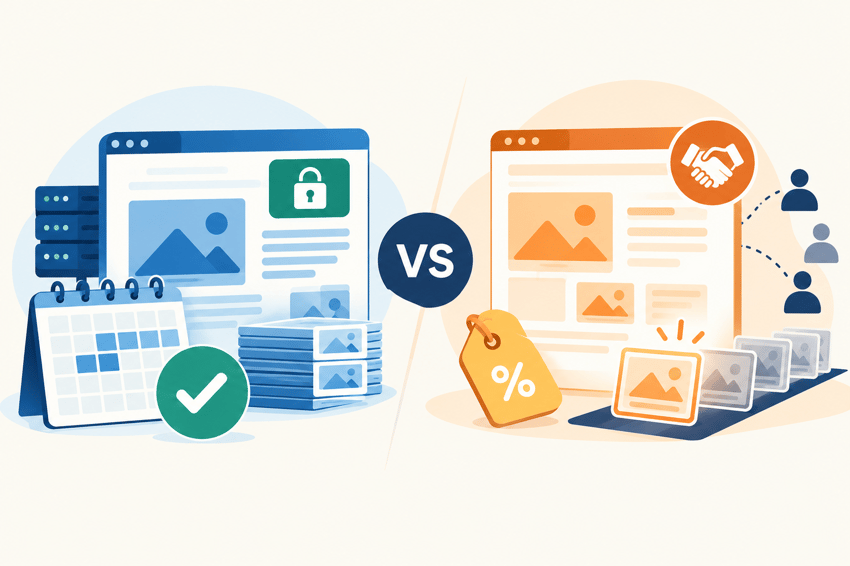
Key Takeaways
|
What is Programmatic Guaranteed?
Think of it like booking a table at your favourite restaurant. You normally call ahead, and the restaurant agrees to hold that table for you. In return, all you need to do is show up and pay up. Guaranteed works the same way, but for ads. Here are the key steps for both parties, viz., publisher and advertiser:
Publisher
- Agrees to set aside a fixed number of impressions.
- Uses (typically) Google Ad Manager to create a proposal and send it to suitable advertisers.
- Assigns a deal ID to the advertiser, allowing them to display their ads.
Advertiser
- Inspects the inventory
- Evaluates the proposal before making the final decision.
- Agrees to pay the exact discussed amount for the impressions. Can’t pause or cut the volume of the campaign.
With programmatic guaranteed, 4 aspects of a campaign are fixed:
- Impressions
- Placement
- Prices
- Dates
The whole idea is you get certainty but give up flexibility. A programmatic direct deal usually has one more key requirement. The advertiser-side agency must sync their Data Management Platform with the publisher’s DMP. They should also allow the agency to analyse the publisher’s inventory and audience before planning the campaign.
Advantages of Programmatic Guaranteed
For Publishers
- Amplified revenue: Freedom to charge a higher price for premium inventory, with a predictable revenue stream.
- Improved brand safety: A clear idea of the visuals and products advertised on their websites /apps.
- Better user engagement and experience: Relevant ads that resonate with the audience, with less risk of disrupting the user experience.
For Advertisers
- Better control: Know the number of impressions and CPM before implementing a campaign, with no hidden costs.
- Improved targeting: Assess a publisher’s inventory and audience to see whether it meets their needs.
- Enhanced security: No third parties, such as an ad network, so lower risk of ad fraud.
- Increased efficiency: No auctions, and routine tasks like insertion orders and exchanging tags are automated.
- Better ROI: Checking inventory and controlling ad placement improves campaign performance and ROAS.
Disadvantages of Programmatic Guaranteed
For Publishers
- Higher barrier to entry: New publishers with a small audience and limited connections may not benefit from it.
- Dedicated team needed: To segregate inventory and communicate with potential buyers.
- Technical knowledge required: To set up a programmatic guaranteed deal and track profits.
For Advertisers
- Higher price: Expect to pay more for inventory.
- No benchmark: No floor price or other bids to show whether the publisher is asking for a fair price.
- Obligation to buy: Once the deal is finalised, advertisers must buy the available inventory, so evaluating the publisher’s reliability matters.
Also read: Why Is Campaign Complexity Growing Faster Than Most MediaOps Teams Can Handle?
What are Preferred Deals?
This is another programmatic advertising type. In this, an agreement is set up between both parties where the publisher agrees to offer preferential access to inventory at a pre-negotiated CPM for advertisers.
Now there is a catch. The inventory isn’t reserved for a specific advertiser. Instead, they can check the inventory and decide whether they want to buy it. If they choose not to accept the deal, the publisher can sell their inventory in a private marketplace or open auction. The publisher can also negotiate preferred deals with various advertisers.
Unlike programmatic guaranteed, Impressions and dates aren’t set in stone. That’s why preferred deals are also known as programmatic non-guaranteed. Here are the key steps for both parties, viz., publisher and advertiser:
Publisher
- Invites advertisers to participate in a preferred deal
- Interested advertisers accept the invitation
- Both parties negotiate terms(impressions and CPM)
- The publisher outlines a proposal and shares it
- Both parties finalise the deal and begin the campaign
Advertiser
- Finds a website or app that fits their requirements and reaches out to the publisher
- Publisher reverts with more details and negotiates the CPM
- Places an order for the inventory
- Publisher reviews the order and begins the campaign
Advantages of Preferred Deals
For Publishers
- Predictable revenue: No need to auction inventory, and prices aren’t driven by bidding. A fixed CPM gives a more predictable revenue stream and more control over revenue.
- Premium price: Publishers set a fixed CPM instead of waiting for bids. Advertisers get the first-look advantage, so they’re willing to pay a higher price, which helps publishers maximise revenue.
- More flexibility: Publishers aren’t dependent on a limited set of advertisers. They can sell inventory in an open market if an advertiser doesn’t accept the deal.
- Quality control: Campaigns run in a brand-safe environment, with better ad performance and quality traffic, because the buyer and seller agree to specific ad placements before finalising a deal. Advertisers can always pass on inventory that doesn’t suit their needs.
For Advertisers
- First-look access: Advertisers see and buy premium inventory before it goes to open auction.
- No obligation to buy: No volume commitment, so they can pass on inventory that doesn’t suit their needs or walk away without penalty.
- Fixed, known price: A negotiated CPM means no bidding wars and no surprise price spikes during peak periods.
- Brand-safe, quality inventory: Campaigns run on a trusted publisher’s site, on placements both sides have agreed on.
Disadvantages of Preferred Deals
For Publishers
- Risk of unfulfilled inventory: Advertisers aren’t obligated to buy. If they pass, the inventory moves to a private auction and then the open market.
- Revenue hit: Inventory may remain unfulfilled throughout these transfers.
- Tough for newer or smaller publishers: Unless well-known, they’ll likely struggle to grab advertisers’ attention.
For Advertisers
- Not set in stone: They might have to compete with other buyers for a particular inventory.
- Higher CPM: Early access to premium inventory costs more than the open market.
- No price benchmark: Assess the publisher’s credibility and trustworthiness before negotiating the price.
- Finding the right publisher: It’s up to advertisers to find one whose audience matches their target demographic, which makes the process more complex and time-consuming.
Also read: Why Every Enterprise Advertising Team Needs a MediaOps Playbook
Programmatic Guaranteed vs Preferred Deals: Summary of Differences
|
Aspect |
Programmatic Guaranteed (PG) |
Preferred Deal |
|
Inventory |
Reserved only for you |
Not reserved. You get first look when it’s available |
|
Delivery |
Publisher commits to a fixed number of impressions |
No delivery promise. Volume can fall short |
|
Price |
Fixed CPM, agreed in advance |
Fixed CPM (negotiated floor), agreed in advance |
|
Buyer’s commitment |
You must buy the agreed volume |
No obligation to buy |
|
Flexibility |
Low. You can’t pause or cut volume without consequences |
High. You can scale up, scale down or walk away |
|
Priority in the ad server |
Highest. Ranks above preferred deals, private auctions and open auction |
Lower than PG. Unsold impressions can fall to open auction |
|
Forecasting |
Easy, since impressions and cost are known upfront |
Harder, since actual delivery depends on availability |
|
Budget pacing |
Predictable |
Can run slow if inventory isn’t available |
|
Risk |
Buyer risks overpaying if the campaign underperforms |
Buyer risks under-delivery |
|
Best for |
Big launches, festive peaks, premium placements like homepage takeovers |
Always-on campaigns, testing a publisher, flexible budgets |
How to Choose Between Programmatic Guaranteed and Preferred Deals?
There’s no single right answer. It depends on how much certainty you need and how much flexibility you can give up.
Choose Programmatic Guaranteed when:
- The campaign is high-stakes, like a product launch, a festive peak or a homepage takeover.
- You need a fixed number of impressions on a specific placement.
- The client expects delivery to match the plan.
- Your budget is locked, and you can commit to the full volume.
- You know and trust the publisher.
Choose a Preferred Deal when:
- You want to first look at premium inventory without a commitment.
- The campaign is always-on, or the budget is flexible.
- You’re testing a new publisher before putting bigger money behind it.
- You can live with some under-delivery.
- You want the option to walk away or shift budget mid-flight.
A simple rule of thumb
If missing the volume would hurt, go guaranteed. If it would only be an inconvenience, go preferred. Many teams use both. They book PG for the moments that can’t go wrong and Preferred Deals for the rest of the year. Whichever you pick, track delivery against the deal. A guaranteed deal still needs monitoring, and a preferred deal needs it even more.
How can Brysa help?
Whether you choose Programmatic Guaranteed or a Preferred Deal, a deal is only as good as its delivery. That’s where Brysa comes in. Our MediaOps team tracks playout continuously against contracted plays and impressions, so under-delivery is caught early and fixed before it becomes a problem. Every creative is checked against spec, with a pass or fail in the first response, which cuts rework and speeds up go-live. Upweights are managed for you, and urgent campaigns get priority, with a 30-minute initial response SLA. The result is campaigns that run as contracted, revenue that’s protected and clients who stay confident. Contact us now to learn more.